How to Deploy Applications on Cloud Servers (2024 Guide)
Moving a web app from your local machine to a live, production-ready environment can be incredibly frustrating. If you’re struggling with this, you definitely aren’t the only one. Figuring out exactly how to deploy applications on cloud servers is a major hurdle for developers everywhere, usually thanks to headaches like configuration drift, mismatched environments, and underlying security risks.
Throughout this guide, we’ll break down the entire cloud deployment process step by step. It doesn’t matter if you’re launching a basic monolithic app, playing around with a home server project, or orchestrating a complex web of microservices. Getting a solid grip on your cloud infrastructure is the key to ensuring high availability, lightning-fast load times, and performance that scales as you grow.
Why Learning How to Deploy Applications on Cloud Servers Can Be Challenging
Most deployment headaches boil down to the classic “it works on my machine” excuse. When you build software on your own computer, your code relies on a very specific ecosystem—your operating system, exact library versions, local databases, and custom environment variables. The catch? Cloud servers are blank slates. They exist as isolated environments that need precise tuning to perfectly mirror the setup you had back home.
If you jump in without a solid plan, you’re almost guaranteed to run into technical friction. This usually happens for three specific reasons:
- Configuration Drift: Even minor discrepancies in software versions between your dev machine and the live host can trigger fatal errors that seemingly come out of nowhere.
- Resource Allocation: It’s easy to underestimate what your live server actually needs. Failing to allocate enough CPU, RAM, and storage limits can cause your app to crash the moment it experiences real user load.
- Network Security: A simple misconfigured firewall, a missing SSL certificate, or a botched port binding is all it takes to accidentally block perfectly legitimate traffic from reaching your site.
Recognizing these common pitfalls is your first real step toward building a deployment system that is both reliable and highly available.
Quick Fixes: Basic Deployment Methods
Sometimes, you just need to get your code live fast without getting bogged down in a massive DevOps workflow. Fortunately, there are plenty of straightforward ways to do exactly that. These simpler solutions are ideal for spinning up Minimum Viable Products (MVPs), creating temporary staging areas, or hosting personal hobby projects.
1. Use Platform as a Service (PaaS)
Without a doubt, the quickest route to deployment is through a PaaS provider like Heroku, Vercel, or Render. These platforms handle all the heavy lifting behind the scenes, completely abstracting the server infrastructure. All you have to do is link your Git repository, and the platform will automatically build and deploy your app every time you push new code.
However, this incredible convenience does come with a couple of trade-offs. PaaS pricing can escalate quickly as your site traffic grows, and you inherently sacrifice a significant amount of control over the low-level server environment.
2. Manual Transfer via SSH and SCP
If you prefer using a traditional virtual private server (VPS) from a provider like AWS, Linode, or DigitalOcean, you can always handle the deployment yourself. This hands-on approach involves securely logging into your machine and moving your production files over manually.
- Connect to your server: Open up your terminal and run
ssh user@your-cloud-ipto gain access. - Provision the OS: Use your server’s package manager to install whatever runtime environments your app needs to function (like Node.js, Python, PHP, or Java).
- Transfer Files: Move your code over using Secure Copy Protocol (SCP), an SFTP client, or simply run a
git clonecommand to pull the files directly onto the remote machine. - Run the App: Launch your application using a robust process manager such as PM2, Supervisor, or systemd. This crucial step ensures your app stays alive in the background long after you safely close your terminal window.
Advanced Solutions: Enterprise-Grade Cloud Deployment
As your user base expands and your team brings on more engineers, relying on manual deployments quickly becomes a liability. The process is simply too time-consuming and prone to human error. From a modern DevOps perspective, the goal is to create systems that are automated, highly reliable, and easily repeatable. Let’s look at how professional engineering teams actually manage their cloud architecture.
Docker Containerization
If you want to eliminate the dreaded environment mismatch problem once and for all, containers are the answer. By wrapping your application, all its dependencies, and its configuration files into a single, neat Docker container, you guarantee that it will behave exactly the same way on any cloud server.
The workflow is remarkably elegant. You write a Dockerfile for your application, build the image locally, and push it up to a registry like Docker Hub or AWS Elastic Container Registry. From there, your production server simply pulls down that exact same image. Today, this methodology is widely considered the gold standard for software delivery, serving as the foundational building block for powerful orchestration tools like Kubernetes.
Building a CI/CD Pipeline
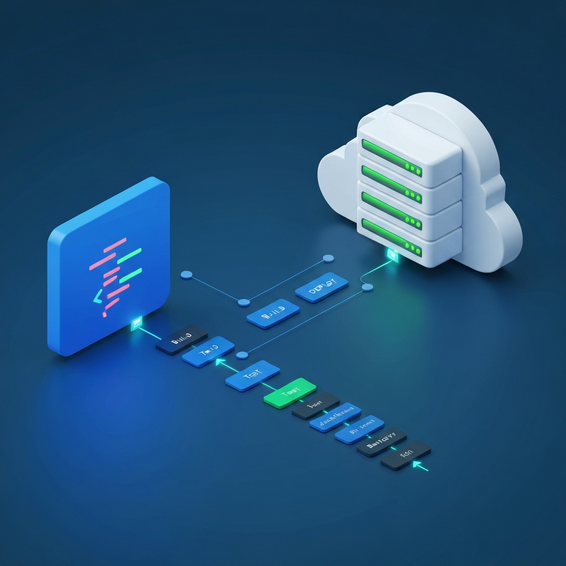
Continuous Integration and Continuous Deployment (CI/CD) pipelines completely automate the testing and release phases of your code. With a solid pipeline in place, you can confidently push updates to production multiple times a day without breaking a sweat. Platforms such as GitHub Actions, GitLab CI, or Jenkins act as automated watchdogs, keeping an eye on your repository for any fresh commits.
The moment you merge new code into your main branch, the magic happens. The pipeline instantly kicks off your unit tests, compiles your newest Docker images, and ships them straight to your cloud infrastructure using automated SSH scripts or provider APIs. By removing humans from the actual deployment step, you drastically cut down on mistakes and accelerate your entire development lifecycle.
Infrastructure as Code (IaC)
Manually clicking through a labyrinth of cloud provider dashboards to provision servers and configure networks is a thing of the past for senior engineers. Instead, they rely on Infrastructure as Code (IaC) tools like Terraform and Ansible. IaC empowers you to write clean, declarative configuration files that programmatically generate your servers, load balancers, and managed databases. Ultimately, this approach guarantees that your staging and production environments remain perfectly identical.
Best Practices for Cloud Servers
Actually getting your code onto the server is really only half the battle. If you want your project to succeed in the long run, you have to prioritize optimal performance, keep downtime to an absolute minimum, and tightly lock down your security protocols.
- Use a Reverse Proxy: It’s never a good idea to expose your raw application directly to the internet. Instead, tuck it safely behind a reverse proxy like Nginx, Apache, or Traefik. These servers are exceptionally good at handling SSL termination, balancing incoming loads, and caching static files.
- Implement Least Privilege Access: Running your web apps as the “root” user is a massive security risk. Always create dedicated, unprivileged accounts with strictly limited permissions just for your application processes. If a hacker manages to compromise your app, this setup significantly restricts the damage they can do.
- Automate Database Backups: In today’s landscape, cloud storage costs practically nothing, whereas losing customer data could bankrupt your business. Set up automated cron jobs to routinely dump your database and ship those encrypted backups directly to a secure external S3 bucket.
- Monitor Logs and Uptime: You can’t fix what you can’t see. Integrate top-tier observability tools like Prometheus, Grafana, or Datadog into your stack. They will proactively alert you the second your CPU usage spikes, a memory leak develops, or users start hitting 500 internal server errors.
- Separate State from Application: Store your active databases and user-uploaded media on entirely separate servers or managed services. By keeping your primary application servers completely stateless, you gain the freedom to destroy, rebuild, and scale them at a moment’s notice without worrying about data loss.
Recommended Tools and Resources
If you’re looking to smooth out your deployment workflow, we strongly suggest checking out the following platforms and utilities:
- DigitalOcean: Easily one of the most intuitive and developer-friendly providers on the market for launching affordable Linux servers. We highly recommend it for both standard Docker environments and traditional VPS hosting.
- GitHub Actions: Arguably the most seamless way to engineer a powerful CI/CD pipeline, conveniently located right next to your actual source code.
- Cloudflare: A non-negotiable addition to your toolkit. It handles modern DNS management flawlessly while tossing in free SSL certificates, aggressive edge caching, and enterprise-grade DDoS protection for your newly deployed web application.
- Portainer: An incredibly handy graphical user interface (GUI) designed to help you visually manage all the Docker containers running on your server. It’s a lifesaver if you don’t want to memorize a textbook of complex CLI commands.
Frequently Asked Questions (FAQ)
What is the difference between a VPS and a PaaS?
A Virtual Private Server (VPS) hands you the keys to the castle—complete root access to an underlying operating system. However, that means you’re on the hook for configuring the network, installing runtimes, and securing the machine manually. On the flip side, a Platform as a Service (PaaS) hides the server details entirely. It lets you focus exclusively on writing your software, while the provider quietly handles the hosting environment, automatic scaling, and ongoing maintenance.
Do I absolutely need to learn Docker to deploy an app?
You can certainly deploy an application without it, but learning Docker containerization is something we strongly encourage. It wipes out frustrating environment-specific bugs, makes scaling a breeze, and has universally become the industry standard for how modern tech companies ship software to the cloud.
How do I secure my cloud server immediately after deployment?
Your very first move should be turning off password-based SSH logins in favor of secure cryptographic SSH keys. Next, set up a strict firewall (such as UFW on Ubuntu) and block every port except HTTP (80), HTTPS (443), and whichever custom port you’ve chosen for SSH. Finally, make it a habit to regularly update your server’s OS packages and your app’s dependencies so you aren’t leaving known vulnerabilities wide open.
Can I deploy a database on the same server as my app?
Absolutely! If you’re building a small project or an MVP, hosting a database like PostgreSQL or MySQL right next to your app is both practical and budget-friendly. Just keep in mind that once your traffic begins to surge, you’ll want to migrate that data to a dedicated database server or a managed service. Splitting them up guarantees better resource allocation and makes backing up your data much less of a headache.
Conclusion
Grasping exactly how to deploy applications on cloud servers is what bridges the gap between tinkering on your local machine and delivering real, tangible value to the public. By first mastering the basics of virtual server management, and then carefully layering in advanced techniques like Docker and automated CI/CD pipelines, you’ll be well on your way to building architectures that are remarkably secure, scalable, and robust.
Ultimately, the best way to master cloud deployment is to roll up your sleeves and dive in. Start small. Try spinning up a cheap $5 cloud server and manually deploying a tiny application just to get a feel for the Linux environment. Once you’re comfortable, start sprinkling in automation and configuration tools. With a bit of practice and persistence, managing your own cloud infrastructure will soon feel like second nature, giving you the confidence to launch any new project the moment inspiration strikes.
About the Author